 |
Denison
WItmer |
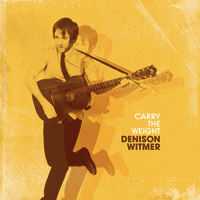
| Burnt Toast Vinyl is proud to release the vinyl version of Denison Witmer's new album, Carry the Weight. btv and Witmer have had a special relationship since meeting in 1997 when btv's Scott Hatch designed Witmer's self-released version of his Safe Away debut. The partnership resulted in a re-issue of Safe Away (2000) on cd and deluxe 180g LP version (2007), as well as the full-lengths Of Joy and Sorrow (2001) and Philadelphia Songs (2002), the eps The '80s (2001) and River Bends (2002), and a special mail-order only Live release (2003). The vinyl version includes alternate cover artwork, a special LP only bonus track, and a coupon for a free mp3 download of the album and bonus track. Denison Witmer doesn't care if people like his new album or not: "I just want them to think I am being honest with them and that I made a valiant effort." And if listeners happen to notice that Carry the Weight is also a beautifully produced, thoughtful nod to the laid-back '70s California pop he's long cherished, the 30-something Philadelphia-based singer/songwriter would be just delighted. But mostly Witmer wants people to embrace hope—something that's easier than might first seem possible with a soundtrack this polished and assured for inspiration. Songs such as the gently affirmative "From Here On Out" and "Chesapeake Watershed," the album's gently emphatic title track, and the chiming, charming sing-along Luddite anthem, "Life Before Aesthetics" mark Carry The Weight as a classic—for fans old and new. For this, his seventh release, Witmer teamed up with Blake Wescott—noted producer of albums by The Posies, Sarah Shannon and Damien Jurado, among others, and drummer for Pedro the Lion. Previously the Witmer and Wescott worked together on Witmer's Of Joy And Sorrow, but Witmer—a veteran of home-studio recording for nearly a decade—was eager to record at a professional studio. "I've never liked the idea of making the same record twice," he states. "I consciously seek out ways to change the sound and arrangements from album to album." What made recording Carry the Weight so special to Witmer was the opportunity to work at the London Bridge Studio in Seattle, where Soundgarden's Louder Than Love and Pearl Jam's Ten were recorded. "I wanted to make a record on the same equipment they used," he explains. "It was really fun to have access to a uninterrupted recording environment, first-class equipment, and instruments I can't afford—like a $40,000 grand piano. Blake encouraged me to take the leap into structuring a project from start to finish in a way that would allow me to maximize my time and budget, as well as get me into a bigger studio to see what could be done." Dollars and
fancy gear aside, what emerged from Witmer's sessions with Blake
is surely the modest troubadour's strongest and most cohesive album
thus far. The pair's shared veneration of the music of such luminaries
as Carole King, Jackson Browne and Leonard Cohen—plus Wescott's
technical know-how—served Witmer's new batch of wistful, unpretentious
tunes most admirably. "Blake knows the records I love in and
out, and he knows how to recreate the sounds we love from those
records. We're been able to push and pull each other without a lot
of drama," Witmer says, "and the outcome has always Though much of Carry the Weight was written on the road over the last few years, with certain aspects of songs and arrangements developing over time, he's quick to admit that, to him, there is no such thing as the definitive version of any song—recorded or live. It's all about "the moment" for Witmer: "I try not to get things too figured out before I get to the studio," he continues, "because I like the element of surprise. There's a lot of freedom in letting go of the 'perfect version of this song' style of recording and just embracing the process of it all... What's captured is a time and place, and whatever feeling that comes from that." Though Witmer doesn't have a band, per se—he usually tours as a solo acoustic act—close friends called in to make Carry the Weight resonate with the sort warmth and fellowship that only comes from a strong affinity and shared aesthetic: "Everyone involved in this project came together in a natural way," he relates. As before, Witmer's lilting voice and deceptively straightforward guitar are the bedrock on which the album is built, but a confident sonic expansiveness is achieved through the perfectly conceived contributions of his chosen fellow travelers: Noah Harris, who plays piano and sings; Rosie Thomas, a friend whose most recent record Witmer co-produced, and who here graces several songs with her luscious vocals; Jeff Shoop (Ester Drang, Sufjan Stevens, Rosie Thomas), a guitarist/keyboardist and former tourmate; and drummer James McAlister (Ester Drang, Sufjan Stevens), longtime friend, collaborator and fellow player with Witmer in Sufjan Stevens' "Michigan Militia" band. Though never forced or falsely cheerful, Carry the Weight offers a very humanistic, transcendental message—one that was a revelation to the songwriter himself, who describes the last few years of his life as "rather difficult." The main difference between the new disc and Are You A Dreamer? (Witmer's last full-length, from 2005), Witmer admits, is that he wasn't feeling particularly hopeful when he started writing songs that eventually became Carry the Weight. "Whether it was the political deterioration of our country, watching terrible things happen to good people, or the repeated mistakes I was making in my own life," Witmer confides, "I had given in to a lot of pessimism. Carry the Weight became an argument with myself about whether or not the hope I have left is real—or just idealistic naiveté. I'm happy to say that hope won the argument." "Can't you see how much I'm trying?" asks Witmer on the album's haunting closer, "One More Day." Anyone who has a heart surely will. |
|