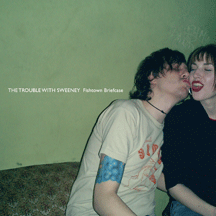
|
Let's
clear it up right now, because we know you're gonna ask what the
hell a Fishtown Briefcase is. For a certain segment of the Philadelphia
population - no doubt TTWS themselves - it is heavy slang for any
30-pack of beer that can be held with a briefcase-style handle or,
better still, held up to the ear in the style of a ghetto blaster,
as if one could listen to the sounds of beer and sweet, summery
desperation itself.
But it's more
than just that. For The Trouble With Sweeney, Fishtown Briefcase
is a follow-up to their critically acclaimed I Know You Destroy
- which garnered Best of 2003 recognition from RollingStone.com
and Amplifier Magazine among others, as well as a growing list of
devoted fans across the country. It's also the point at which, after
threatening to do so for a while, the group throws themselves headlong
into the realm of California-top-down music, where barefoot girls
dance in pizza parlors in the hills.
At least
that's what Sweeney thinks. "The 'Case is all about us, like,
expanding our minds through the making of happy, rocking music,"
he says, with a characteristic wisp of his long blonde wig falling
into this face. "Stuff that you might be able to actually dance
to, if you traveled back in time to the pizza parlor discos of Southern
California in the late 1970s. Very Robbie Benson." Can you
dig it?
Like Destroy, a fair chunk of the songs here are detailed character
studies, except this time Sweeney's characters are personal to him.
"Yep," Sweeney says, "Songs about people: Evelyn
Rochman, my dad's wife's friend who played the Modern Lovers for
me in high school and who I was secretly in love with. Malcolm Smith,
motocross legend and object of Steve McQueen's repressed sexual
fantasies. And Young Song, who dated my buddy Joseph for a while,
was/is a fashion designer and the first person I ever met who had
gold plated Technics 1200s."
The most autobiographical and what could have been the title track
"The City Let Me" (a video is enclosed) is an homage to
growing up and being influenced by a city like Philadelphia.
Overall, you're seeing a more honest TTWS on this record.
Maybe a little too honest, by including a cover of the Wings classic
"Listen To What The Man Said" (LTWTMS). A non-guilty
pleasure that is not ironic in the least, it's meant as a shout-out
across time from an indie rock band coming to terms with the feelings
that only a Wings cover can provide. Heavy feelings. Hairy feelings.
Mental feelings.
|